Sunday of the Passion or Palm Sunday
Jesus Rides into Jerusalem as a King
And, a Week Later, Walks to a Humiliating Death
The last week of Jesus'
life was crammed with events, as we follow him from his glorious
entry into Jerusalem on Sunday until his death on Friday. In the
days in between, he preached, taught,
presided over the Passover supper, stood trial, and was condemned
to death. We call this week Holy Week.
Palm Sunday
Luke 19: 28 - 46
Matthew 21: 1 - 17
Mark 11: 1 - 11
John 12: 12 - 50
John 2: 13 - 15
On Palm Sunday we study two sets of lessons.
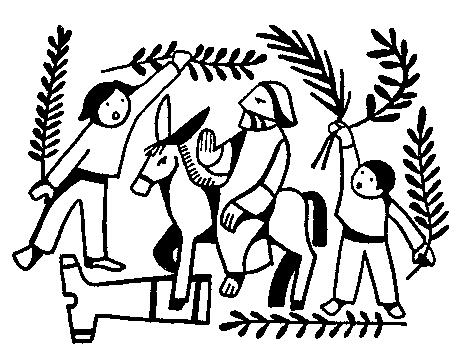
The first set is about Jesus' ride into Jerusalem on a colt, fulfilling
the prophecy in Zechariah 9: 9. The people greeted him as though
he were an earthly king; they were sure he would end the Roman
occupation, and Jerusalem would again be a Jewish city.
They shouted, "Hosanna,"
which means "save us," and comes from Psalm
118: 26.
And the second set are a detailed look at what happened in the week between Palm Sunday and Easter Sunday. We also read the Psalms which form a foundation for the events of Holy Week.
The color of Palm Sunday
is red.
The time in the Gospel writers' accounts may be compressed. Their
story is about being overwhelmed by the presence of Jesus,
not an historical account of places or dates.
Calendar | HomePage
| References and Resources | Lent
| Sunday of the Passion Lesson | Sunday of the Passion Art | Palm
Sunday Art | Confirmation
Instruction Overview | Confirmation
Instruction Lesson 13| The Psalms of Holy Week
Jesus Teaches and Preaches
Luke 21: 31 - 38
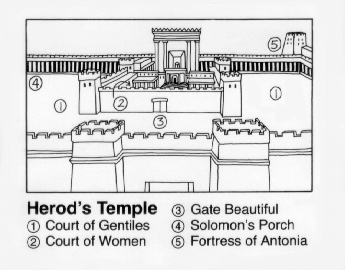
After his warm welcome into Jerusalem, Jesus taught in the Temple for a few days. Luke
places many of Jesus' stories or parables during this time.
We study many of these stories during Lent.
Jesus' Enemies Conspire
Against Him
Luke 22: 1 - 2
Matthew 26: 1 - 5
Mark 14: 1 - 2
John 11: 47 - 53
Pontius Pilate and his soldiers
went from Caesarea on the Mediterranean coast inland to Jerusalem
every year for the Feast of the Passover. They were afraid that
so many Jews gathered together from all of Palestine
would start riots against the Roman government.
The Jewish Sanhedrin, the council
of elders, played on Pilate's fears, because they were afraid
that Jesus would start a religious revolution against them. They
thought that if the people would follow Jesus' new ways of teaching
and healing, the Sanhedrin would no longer have power in the Temple.
A Woman Washes Jesus'
Feet and Dries Them with her Hair
Luke 7: 36 - 50
Matthew 26: 6 - 13
Mark 14: 3 - 9
John 12: 1 - 22
This story
is told several times, taking place in different locations. John places it firmly in Holy Week,
with Mary, the sister of Martha and of Lazarus, as the woman.
Mark includes the story in Holy Week, two
days before the Feast of the Passover, but Mark says it took place
at the home of Simon, the leper, and he does not name the woman.
Lazarus and his sisters were close personal friends of Jesus.
He and his disciples stayed with them often in Bethany, and because
raising Lazarus from the dead was
the great miracle of Jesus that the people of Jerusalem knew about,
the high priests and elders wanted to kill Lazarus as well as
Jesus.
Judas Betrays Jesus
Luke 22: 3 - 6
Matthew 26: 14 - 16
Mark 14: 10 - 11
John 18: 2 - 5
Judas told the Temple guards how to find and arrest Jesus in a
quiet place at night; they were afraid there would be riots if
they arrested him in the daytime in the city.
Because the Gospel writers were so angry at Judas for his participation
in Jesus' death, we do not have a clear picture of him.
He was called Judas Iscariot, or Judas, the son of Simon Iscariot,
which may mean that his whole family belonged to a radical political
group.
He was chosen by Jesus to be one of the original twelve disciples.
Judas was the treasurer for the disciples, even though Matthew
the tax collector also knew about money and finances.
And we know that Judas was so devastated by the part he played
in Jesus' death that he killed himself, either by hanging or by
disembowelment in the Roman fashion (somewhat like Japanese hara-kiri).
Jesus Prepares for the Last Supper and Washes the Feet of His
Disciples 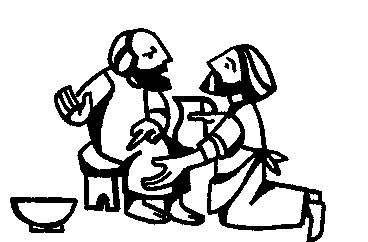
Luke 22: 7 - 13
Matthew 26: 17 - 19
Mark 14: 12 - 16
John 13: 1 - 20
Passover lasts for eight days, and the preparation for it is like the preparation for Christmas - it isn't all done in one day.
All leaven (yeast, baking powder, baking soda) must be removed from the house, and the house must be cleaned thoroughly to make sure no bread or cookie crumbs remain. Special foods are eaten for the entire eight days (no leaven is allowed back into the house), beginning with the Seder supper on the first night of Passover.
In Jesus' day, each family
would sacrifice a lamb at the Temple, bringing part of the lamb
home for their Seder supper.
Jesus Identifies His Betrayer
Luke 22: 14, 21 - 23
Matthew 26: 2 - 25
Mark 14: 17 - 21
John 13: 21 - 30
Jesus knew who would betray him to the Temple guards, but he also
knew that for the prophecies to come true, he must accept what
would be done to him. With no death, there could be no resurrection.
Jesus Presides over the Passover Supper
Luke 22: 14 - 20
Matthew 26: 26 - 29
Mark 14: 22 - 25
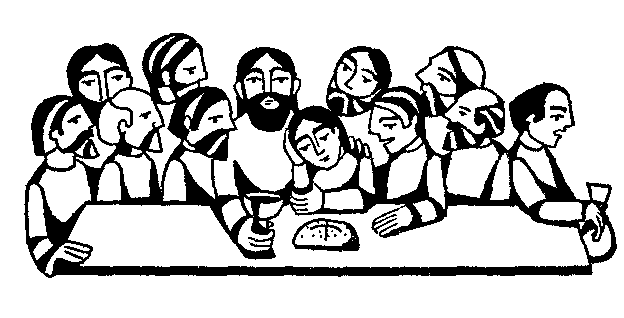
There is some disagreement between the Gospel writers on when
this meal took place. For Luke,
it is a true Passover meal, with the blessing of the wine before
the bread. For the others it may be a pre-Passover meal with the
two Jewish blessings, one for the bread and one for the wine.
John's imagery encourages us to
see Jesus as the true Lamb of God, sacrificed at exactly the same
time the lambs were slaughtered in the Temple for the Passover
meals.
Whichever meal this was, it took place during the time of the
Passover, when Jews remember that God freed them from slavery
in Egypt, and it is the meal where Jesus asked us to remember
that he freed us from our slavery to sin.
Christians participate in this meal in the Sacrament of Holy
Communion.
Jesus Knows Peter Will Pretend He Doesn't Know Him
Luke 22: 21 - 38
Matthew 26: 31 - 35
Mark 14: 27 - 31
John 13: 36 - 38
Peter
of the changing enthusiasms was so sure that if Jesus died, he
would die too. But Jesus knew otherwise, telling Peter that he
would deny knowing him three times before the rooster
crowed at sunrise the next morning.
Jesus
Prays while His Disciples Sleep
Luke 22: 31 - 33
Matthew 26: 36 - 46
Mark 14: 32 - 42
John 18: 1
Jesus knew what was in store for him that night (Thursday) and
on Friday as well. So he took his disciples to a quiet place to
pray, the garden of Gethsemane on the Mount of Olives. The disciples
fell asleep while he prayed, Luke says, "because of grief".
In their own way, they, too, were preparing for the terrible times
to come.
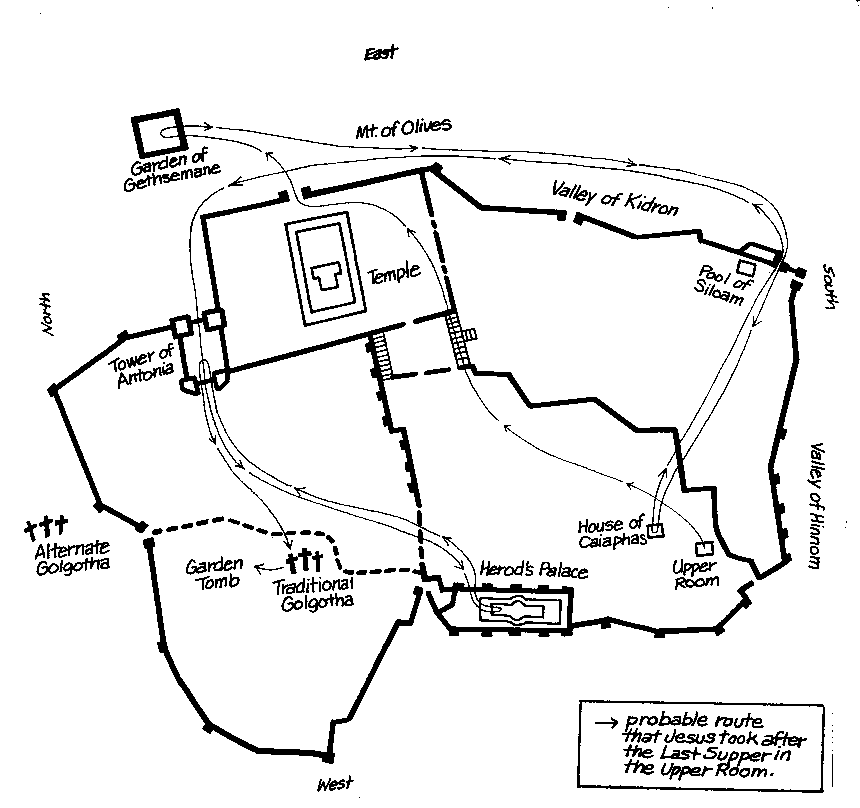
The Temple Police Arrest Jesus
Luke 22: 47 - 53
Matthew 26: 47 - 56
Mark 14: 43 - 52
John 18: 2 - 12, 20
Three distinct groups of guards or soldiers play a part in this
story. Both Pontius Pilate and Herod Antipas
had their own troops, and troops (probably Pilate's) were garrisoned
in Jerusalem, even though Pilate's official residence was in Caesarea,
on the Mediterranean coast (Jerusalem is inland.)
The first troops to appear, however, are called guards or temple
police. They took direction from Caiaphas, the Jewish high priest,
and the Jewish council of elders. They were the guards who arrested
Jesus. The Roman soldiers appeared later.
Peter
Doesn't Know Who Jesus Is
Luke
22: 54 - 62
Matthew 25: 69 - 75
Mark 14: 66 - 72
John 18: 15 - 18, 25 - 27
Even though Peter said he would follow Jesus to his death, before
the rooster crowed at sunrise on Friday morning, Peter said three
times that he did not know Jesus or any of his friends. And even
though it was obvious from his accent that he was a Galilleean,
he said he did not come from Galilee.
Jesus Is Teased, Slapped, and Beaten
Luke 22: 63 - 65
Matthew 26: 67 - 68
Mark 14: 65
The temple guards, the followers of the Jewish council of elders,
and perhaps even the elders themselves taunted and slapped Jesus
after they arrested him. They finished their torment with a beating,
and then took him to the house of Caiaphas, the Jewish high priest.
Jesus Stands before the Council
Luke 22: 66 - 71
Matthew 26: 57 - 68
Mark 14: 61 - 64
John 18: 12 - 14, 19 -24
The Sanhedrin, or council of elders,
charged Jesus with blasphemy, which means to talk
to or about God with disrespect. Considering the Jewish belief
in the One God, it was disrespectful of Jesus to say that he was
God's son, or to call him "Abba," which means Daddy.
The Romans believed their Emperor was a god living on earth, so they understood the Jewish belief, and in Palestine, respected it some of the time.
Christians, of course, believe
that Jesus was exactly right, that he was the Son of the Living
God, and that he was resurrected as the second person of the Triune
God as they state in the Apostles' Creed.
Jesus Answers Pilate
Luke 23: 1 - 5
Matthew 27: 1 - 2, 11 - 14
Mark 15: 1 - 5
John 18: 28 - 38
Pontius Pilate was a Roman citizen, sent
by the emperor of Rome to be the procurator or governor of Palestine. He had his own army and presided
over his own courts of law.
Pilate was the man who called
Jesus, King of the Jews.
Jesus Stands Silent before Herod
Luke 23: 6 - 12
Herod Antipas was the son of King Herod
the Great whom the three Wise Men visited when they were searching
for the Baby Jesus. Herod Antipas had previously told his soldiers
to cut off John the Baptist's head.
Pilate sent Jesus to Herod because Herod was the tetrarch (or
ruler of one-fourth of Palestine) of Galilee, the area in the
north of Palestine where Nazareth lies,
where Jesus grew up. Herod held less power and territory than
Pilate, so it would be easy for Pilate to blame Herod if things
went badly.
Pilate Releases an Innocent Man
Luke 23: 17 - 25
Matthew 27: 15 - 26
Mark 15: 6 - 15
John 18: 38 - 40
John 19: 4 - 16
Pilate believed Jesus was innocent, but because he was afraid
that the crowds might riot, he allowed the Jewish court of elders
to make the decision to execute Jesus. The crucifixion, however,
was done by Pilate's soldiers, because the Temple guards who reported
to Caiaphas did not have the power to put anyone to death by crucifixion.
The Soldiers Make Fun of Jesus
Matthew 27: 27 - 31
Mark 15: 16 - 20
John 19: 1 - 3
The Roman soldiers took Jesus to their quarters and made fun of
him in a "king for a day" ritual that they may have
performed on Roman holidays. The soldiers crowned Jesus with thorns and put a purple cloak on him.
Choosing a make-believe king and tormenting him may have been
a way of letting go of their anger at cruel rulers.
Jesus Walks to His Death on Golgotha
Luke 23: 26 - 43
Matthew 27: 32 - 44
Mark 15: 21 - 32
John 19: 17 - 24
Increasingly aware that he was fulfilling the Old Testament prophecies
about the Messiah, Jesus walked quietly to his death, after making
the firm, strong speech to the crowd we find in the Luke passage.
The Romans had several methods of executing criminals. Crucifixion, in which people slowly suffocated from the burden of their own weight on their chests, was both the most painful and the most humiliating.
Other Roman methods of execution included garroting (strangling with a special cord or wire) or beheading (cutting off the criminal's head with a sword). Both these methods were considered more dignified than crucifixion, as well as being much quicker and much less painful.
The two criminals (or bandits)
who were executed with Jesus are nameless. They may have been
highway robbers: simple theft may not have been a serious enough
crime to demand crucifixion as the means of death. Only in the
passage in Luke do the two men enter into conversation with Jesus.
The Sky Turns Black and the Curtain Is Torn